
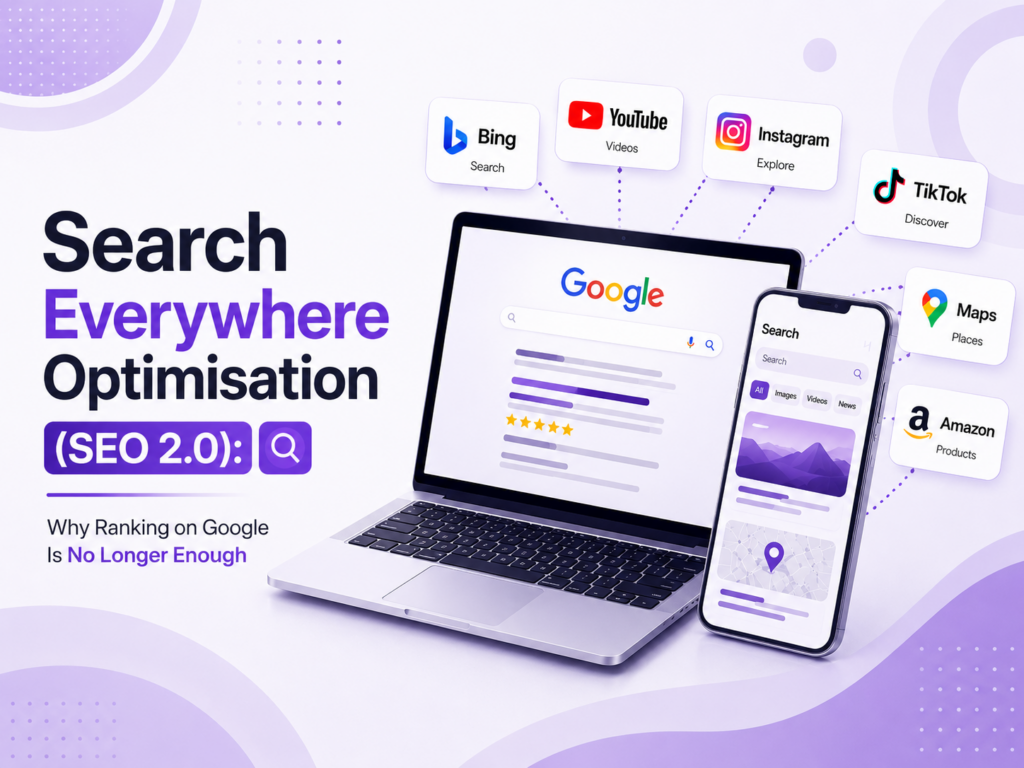
For more than 25 years, Search Engine Optimisation (SEO) has largely meant one thing: helping your website rank higher on Google.
But the way people search is changing faster than ever.
Today, customers don’t just “Google it.” They ask ChatGPT, use Microsoft Copilot, search on Bing, watch YouTube videos, look for products on Amazon, find local businesses on Google Maps, and increasingly use social platforms like TikTok and Instagram as search engines.
This shift has given rise to a new way of thinking about digital visibility:
Welcome to Search Everywhere Optimisation (SEO 2.0)
Search Everywhere Optimisation is about ensuring your business is visible wherever your customers search, not just on Google.
Whether someone is searching through a traditional search engine, an AI assistant, a map application, a marketplace or a social platform, your business should be easy to discover and recognised as a trusted source of information.
Businesses that focus only on Google rankings are increasingly missing opportunities to connect with customers across a growing digital ecosystem.
Search Is No Longer One-Dimensional
A customer looking for a marketing agency today might:
- Ask ChatGPT for recommendations.
- Search Google for local agencies.
- Read reviews on Google Business Profile.
- Watch YouTube videos explaining SEO.
- Search LinkedIn for expertise.
- Browse Instagram for recent client work.
- Compare agencies on Facebook.
The customer hasn’t used just one search engine; they’ve searched everywhere.
That’s why modern SEO must evolve.
The Numbers Tell the Story
Although AI is transforming how people find information, traditional search remains incredibly important.
The latest industry figures paint an interesting picture:
| Platform | Approximate Daily Searches / Prompts | Why It Matters |
| Google Search | ~14 billion searches/day | Still the world’s largest search engine, with approximately 90% of the global search market. |
| ChatGPT | ~2.5 billion prompts/day | One of the fastest-growing AI platforms. Not every prompt is a search, but many users now begin research with AI. |
| Microsoft Bing | ~600–700 million searches/day (estimated) | Powers Bing Search and supports Microsoft Copilot, while also contributing to ChatGPT Search’s live web search experience. |
| DuckDuckGo | Tens of millions of searches/day | A privacy-focused search engine that draws on Bing alongside its own technologies. |
| Yahoo Search | Millions of searches each month | Continues to rely on Bing’s search index. |
The important takeaway isn’t that AI has replaced Google.
It’s that people are diversifying how they search.
Instead of relying on a single platform, customers now move seamlessly between search engines, AI assistants, maps, video platforms and social media before making purchasing decisions.
Bing Has Become More Important Than Ever
For many years, Bing was considered simply Microsoft’s alternative to Google.
Today, Bing plays a much bigger role.
Its search index powers or contributes to multiple search and AI experiences, including:
- Microsoft Bing Search
- Microsoft Copilot
- ChatGPT Search (for live web search)
- Yahoo Search
- DuckDuckGo (alongside its own crawler and other sources)
- Microsoft Start
- Windows Search
- Microsoft Edge search experiences
This means that optimising your website for Bing isn’t just about appearing in Bing Search.
It helps improve your visibility across a much broader digital ecosystem.
AI Search Is Changing Customer Behaviour
Instead of typing a few keywords into a search engine, people are increasingly asking detailed questions.
For example, rather than searching:
“SEO agency Melbourne”
They might ask:
“Who is the best digital marketing agency for construction companies in Melbourne?”
Or:
“Can you recommend a marketing agency that specialises in local SEO and AI search optimisation?”
AI assistants are designed to provide direct, conversational answers.
To become part of those answers, businesses need more than good rankings; they need trustworthy, well-structured and authoritative content.
From Search Engine Optimisation to Search Everywhere Optimisation
Traditional SEO focused on:
- Keywords
- Rankings
- Backlinks
- Organic traffic
Search Everywhere Optimisation expands this approach.
It includes optimising your digital presence across:
- Google Search
- Google AI Overviews
- Bing
- ChatGPT Search
- Microsoft Copilot
- Perplexity AI
- YouTube
- Google Maps
- Apple Maps
- Amazon
- TikTok
- Industry directories
- Review websites
Your online presence becomes an interconnected network of trusted information rather than simply a website trying to rank on Google.
What AI Looks For
Large Language Models don’t simply “know” everything.
When they retrieve current information, they rely on trusted search indexes, authoritative websites and high-quality content.
Businesses that regularly publish:
- Helpful blogs
- Detailed service pages
- Frequently Asked Questions
- Case studies
- Customer reviews
- Industry insights
- Updated website content
are far more likely to become trusted sources that appear in AI-generated responses.
Technical SEO Is More Important Than Ever
As AI search grows, technical optimisation remains essential.
Every business should:
- Register with Google Search Console.
- Register with Bing Webmaster Tools.
- Submit XML sitemaps.
- Enable IndexNow where supported.
- Implement Schema Markup (structured data).
- Optimise website speed and mobile performance.
- Regularly refresh existing content.
- Monitor indexing in both Google and Bing.
These technical foundations help search engines and AI platforms discover, understand and trust your website.
The Future Isn’t Google vs AI
One of the biggest misconceptions is that AI will replace Google.
Julie Merrett, Reach Marketing Group says, “this is simply not true, and the reality is much more interesting. Consumers now use multiple platforms throughout their buying journey.”
They might:
- Ask ChatGPT to explain a topic.
- Verify information on Google.
- Watch YouTube demonstrations.
- Compare reviews.
- Search Maps for nearby businesses.
- Visit social media to see recent work.
- Return to Google before making contact.
This is why the future isn’t about ranking on one search engine.
It’s about being visible everywhere your customers are searching.
The Reach Marketing Group Approach
Reach Marketing Group strongly believes successful digital marketing is no longer measured by Google rankings alone.
It’s measured by digital visibility across the entire search ecosystem.
Our approach combines:
- Traditional SEO
- AI Search Optimisation
- Bing optimisation
- Technical SEO
- Local SEO
- Content marketing
- Authority building
- Website performance
- Structured data implementation
Because in 2026, customers don’t search in just one place.
They search everywhere.1
And your business should be ready to meet them wherever they are.
Sources
- StatCounter Global Search Market Share – Google continues to hold approximately 90% of the worldwide search engine market: https://gs.statcounter.com/search-engine-market-share
- Google Search statistics – Google processes an estimated 14 billion searches per day (multiple industry analyses based on Google’s published figures).
- OpenAI / industry reporting – ChatGPT handles approximately 2.5 billion prompts daily, reflecting the rapid adoption of AI assistants for information retrieval and productivity.
- Microsoft Bing Webmaster Blog – Bing powers a growing ecosystem of search and AI experiences, including Microsoft Copilot and Bing Search: https://blogs.bing.com/webmaster
- IndexNow Project – https://www.indexnow.org/
- Google Search Central – https://developers.google.com/search
- Google AI – https://blog.google/products/search/