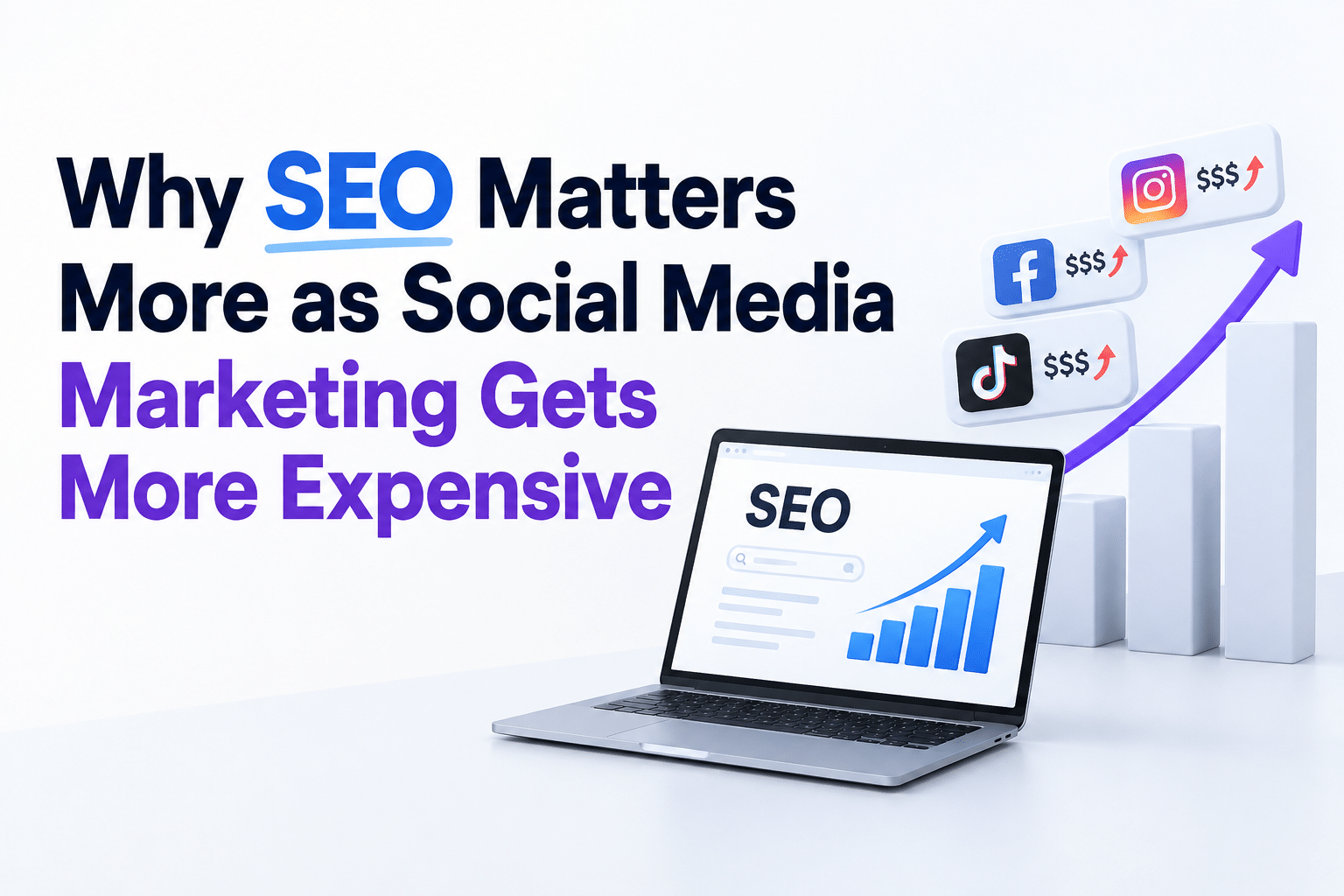
How many times should a business have to pay to reach its customers?
For years, businesses have been encouraged to build audiences on Facebook and Instagram.
And for good reason.
Social media gives businesses extraordinary access to customers and provides powerful tools for awareness, advertising, engagement and remarketing.
But the economics of social media marketing continue to change.
Organic reach has become more challenging.
Many businesses invest in paid advertising to reach meaningful audiences.
Verification is available through paid subscriptions.
Enhanced support and additional business features sit behind higher subscription levels.
And now some Facebook pages are encountering restrictions on how many organic posts can contain external links.
For businesses, these aren’t necessarily reasons to stop using Meta.
They are reasons to reconsider where the foundations of their digital marketing strategy sit.
The cost isn’t just the subscription
Consider a business already paying for:
- Meta advertising.
- Google Ads.
- Email marketing software.
- Website hosting.
- CRM software.
- Graphic design.
- Video production.
- Marketing management.
- SEO.
- Online booking or ecommerce systems.
Now add another subscription for Meta verification or additional functionality.
In October 2026, Reach Marketing Group was offered Meta Verified Business subscriptions ranging from AU19.99 to AU603.19 per month.
Another Australian business account was offered Meta One Advanced at AU$61.99 per month.
These costs exist before the business spends anything on Meta advertising.
Individually, some may be relatively small.
Collectively, they matter.
This is why SEO is becoming more important
SEO isn’t simply about “getting to number one on Google”.
It is about making your business discoverable when prospective customers actively search for what you provide.
A good SEO strategy strengthens the digital asset that sits at the centre of your business: your website is where you
- can properly explain your services.
- Showcase your work.
- Publish authoritative content.
- Answer customer questions.
- Generate enquiries.
- Take bookings.
- Sell products.
- Collect legitimate subscriptions.
- And create conversion pathways designed around your business rather than another platform’s rules.
Paid visibility disappears when you stop paying
Paid advertising has an important role.
Reach Marketing Group manages paid campaigns because advertising can produce excellent results when properly targeted, measured and optimised.
But paid and organic visibility work differently.
When an advertising campaign stops, the traffic generated by that advertising generally stops too.
SEO can create longer-term visibility.
A well-developed service page that earns strong organic rankings may continue bringing prospective customers to a website month after month.
A useful article can answer searches long after its publication date.
A strong local SEO presence can help a business appear when nearby customers are looking for exactly the service it provides.
That doesn’t make SEO free.
It makes SEO an investment in an asset.
Search traffic also has intent
Think about the difference between these two people.
One person is scrolling through Facebook and sees an advertisement for a landscaper.
The other searches Google for:
landscape designer Melbourne
The first person may become interested.
The second is actively looking.
Or consider:
family lawyer Melbourne
accountant near me
live music Bunbury this weekend
website designer Melbourne
These searches reveal intent.
Good SEO puts businesses in front of customers when that demand already exists.
Your website should be more than an online brochure
This is where many businesses still have work to do.
A website shouldn’t simply contain a homepage, About page and Contact page.
A strong business website can have detailed individual service pages, location content where appropriate, FAQs, case studies, articles, resources, strong internal linking and clear conversion pathways.
Each useful page creates another opportunity to answer a relevant search.
Over time, that creates a much larger digital footprint.
Build your own audience too
SEO is only part of the solution.
Businesses should also think seriously about their customer database.
If someone discovers your business through Facebook, don’t make Facebook the end of the relationship.
Bring them to your website.
Encourage appropriate subscriptions.
Capture legitimate enquiries.
Use ticketing and booking systems that help businesses understand their customers.
Develop email marketing where consent allows.
Encourage repeat visits.
The objective is to transform someone else’s audience into a direct relationship with your business.
Social media is a rented space
This doesn’t mean Facebook or Instagram are bad investments.
They aren’t.
They can be exceptionally effective.
But they are platforms your business uses, not platforms your business owns.
Meta determines the rules.
Google determines Google Ads pricing and policies.
TikTok determines its algorithm.
LinkedIn determines what appears in its feeds.
Your business has influence over these platforms, but not control.
Your website is different.
Your content is different.
Your customer database is different.
Your brand is different.
These are assets you can develop.
The strongest strategy isn’t SEO versus social media
Businesses shouldn’t respond to rising social media costs by abandoning social media.
The stronger approach is diversification.
Social media creates awareness.
It introduces people to your brand and keeps the business visible.
Paid advertising accelerates reach.
It allows businesses to target audiences and generate immediate traffic and leads.
SEO captures existing demand.
It helps businesses appear when prospective customers are already searching.
Your website converts interest.
It provides the depth of information and conversion pathways that a social media post cannot.
Email and CRM retain the relationship.
They allow businesses to continue communicating with customers who have chosen to hear from them.
These channels should support one another.
What happens when a platform changes the rules?
Facebook’s emerging external-link restrictions provide a useful example.
A business may have spent years building a substantial Facebook following.
Then the platform changes how links work.
The business can adapt.
It may pay for Meta One.
It may use fewer links.
It may increase advertising.
But it cannot determine Facebook’s policy.
A business with strong Google rankings, direct website traffic, an email database and other acquisition channels has options.
A business entirely dependent upon Facebook has far fewer.
Build assets, not just followers
Followers matter.
Reach matters.
Engagement matters.
But businesses should ask what they are building underneath those metrics.
Are more people searching for the brand?
Is website traffic increasing?
Are Google rankings improving?
Is the email database growing?
Are enquiries increasing?
Are customers returning?
Is the business becoming less dependent upon any single platform?
Those are much more important long-term questions.
SEO is not an optional extra
For businesses facing higher advertising costs, more subscriptions and increasingly complex digital platforms, SEO should not be something considered only after everything else has been paid for.
It should form part of the foundation.
Reach Marketing Group believes businesses should continue using social media and paid advertising where those channels deliver results.
But businesses also need to invest in what they control.
- Build your website.
- Build your search visibility.
- Build useful content.
- Build your database.
- Build your reputation.
- Build your brand.
Then use Meta, Google Ads and other platforms to amplify those assets.
Because the stronger your own digital assets become, the less vulnerable your business is when somebody else’s platform changes the rules.
Want to know more? Contact us for more information